

Bull Whip
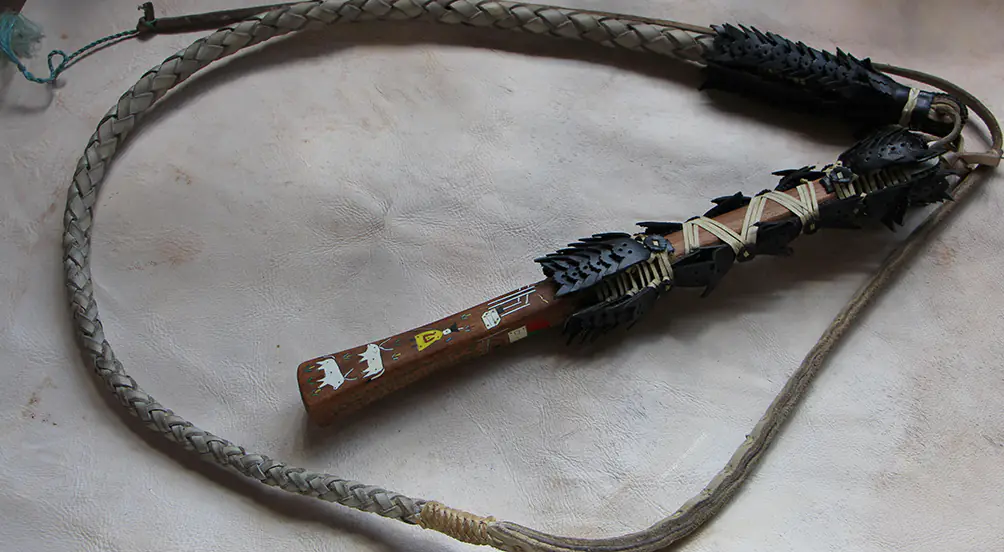
The karikás ostor (traditional Hungarian whip) is the primary and most ornate tool of Hungarian herders, with origins tracing back to the pre-conquest, eastern heritage. It is still crafted and used today by the csikós (horse herders) and gulyás (cattle herders) of Hortobágy.
A well-made whip was not only a practical tool but also a badge of honor and decoration for the herder. Masterfully wielded, it served as a defense against both robbers and wild animals. The name "karikás" comes from the copper or iron ring that connects the whip's multiple braided strands at its neck.
Herders in Hortobágy often make their own whips, decorating the handle with inlaid patterns, a technique known as "kiverés" (carving or inlaying). Common motifs include iconic elements of the plains, such as the well sweep (gémeskút), Hungarian Grey Cattle, Racka sheep, Puli dogs, and the Nine-Arch Bridge.
It is a source of pride that in 2015, the karikás ostor was included in the County Register of Values as an outstanding example of Hungarian pastoral artistry.